It was a comfortable semisleeper bus playing the movie Golmal3 :-)
Boarded at chembur at 9:30 and readched Dharwad at 7:15am.
Freshened up and had breakfast at a very good restarant called Hoysala. It is just a 2min walk from where the bus stopped which is near the Dharwad court.
In the bus from mumbai we were 8 of us including Adesh and Mandar.
6others who had travelled from banglore and 1 from hyderabad met us at Dharwad.
After hefty brekfast we left for dandeli (50km from Dharwad).
We reached Dandeli forest office for acquiring the permit at 10:30am.
Right in front of the office is a timber depot.
we had just got off from our jeeps and someone exclaimed a woodpecker. It turned out to be white bellied pied woodpecker.
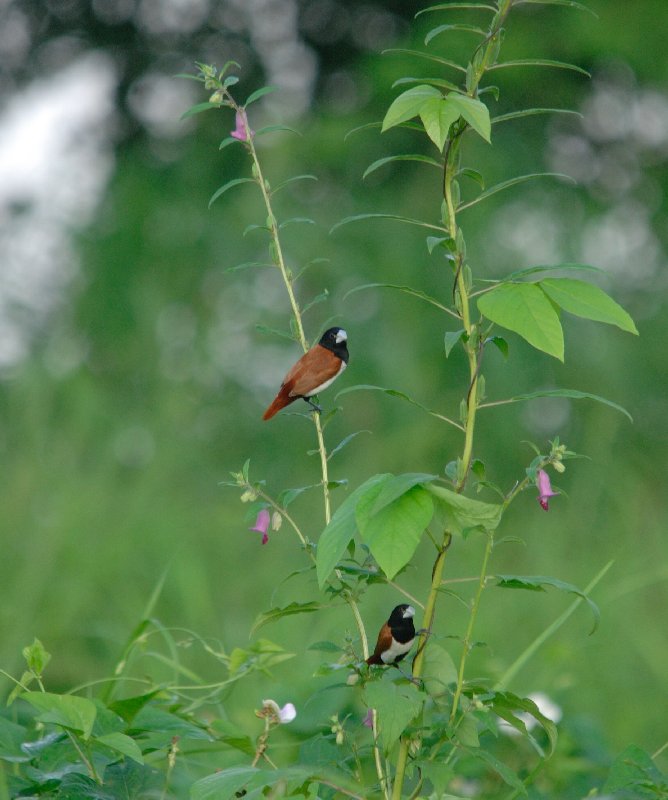
After that followed a frenzy of activity. Bang on the first tree we encountered there were chestnut tailed starlings (blythii), chestnut bellied nuthatch, velvet fronted nuthatch, scarlet minivet. Then we saw the black lored tit, great tit, common woodshrike, white rumped munias.
The list went on to become around 20-25odd species.
All in all a fantastic start to the trip.
Chestnut tailed Starling

White rumped munia

Black lored tit

After collecting the permit we proceeded towards kulgi nature camp around 15km from here.
We were alloted rooms, we freshened up and had lunch nice lunch.
The Kulgi nature camp is at a very nice location in midst of the forest.
It has ordinary tents(with no attached baths) and executive tents (attached baths) but all furnished with one small cupboard, one CFL lamp which used to give enough light, one stand fan, cots with pillows and blankets.
In front of the huts was a big open space with a few trees. Adesh showed a branch of the tree which was the favorite spot of the grey nightjar to be seen at night.
There was a four sided open dining place with a big table which could accomodate all 15 of us.
After lunch we strolled for a little while in the campus of the camp.
There is a nature interpretation center on one side of the camp and a bridge over a small stream connects the two.
Dr Ravi rajgopal had spotted a black throated munia here before the lunch so a few of us went to explore this location.
we spotted a purple rumped sunbird, common iora and plum headed parakeets here.
Common iora

Just when we were about to leave we heard a loud noise and spotted the Malarbar giant squirrels. One of them stayed enough to give us some shots.
After that we proceeded towards supa dam and Ganesh gudi.
Just outside the camp the great flameback was calling aloud.
We got very good views of it before it flew into some thick trees.
On the way to supa dam a pair of pied hornbills flew over the road and settled on a far tree.
Immediately the spotting scope was in place and we could observe the difference between the male and the female with the female having a white arounds its eyes.
There is an inner road which sees over the supa dam.
We got off from our jeep at the start of the road and decided to walk over it. Its kind of an elevated road. On one side is the dam waters and on the other side is a thick vegetation. In the far side on the water side there were bamboo thickets and we could see a lot of activity everywhere. Birds seen here were small green beeeater, common iora, purple sunbird.
On one of the trees there was a lot of activity of sunbirds. On looking through the binoculors one could see many crimson backed sunbirds displaying there wonderful crimson backs.
Crimson backed sunbird

There were some golden orioles, ashy drongos and a verditer flycatcher
Verditer flycatcher and a Golder oriole

On the slopes on the vegetation side Riyaz spotted a grey necked bunting, an unusual find for this area. So it was a nice surprise. Above all this it gave us very good time to observe and also approch it very close for taking good pictures.
Grey necked bunting

On the bamboo thickets we good see nicely even through the scope flocks of munias, petronia and very beautiful small minivets.
The star attraction to search here was the asian fairy bluebird and finally we spotted a pair at the far end of this road. A very beautiful species indeed.
Asian fairy bluebird

We were getting late to see the malabar pied hornbills coming to roost from the Ganeshgudi bridge. We reached there at around 5:30pm and were welcome by a pair of hornbills sitting on a bamboo branch. Soon after another pair flew above us from right side to left side. A single hornbill gave us good views from the top of another bamboo branch.
Malabar pied Hornbill


Once it started getting dark we decided to call it a day.
We had tea and onion pakodas at a place little ahead from the bridge.
Once back to kuligi after a short rest we headed for the dinner.
It was already late and As everyone was tried by the nights journey we decided to have a short night trail. We could hear flying squirrels and frogmouth but no sightings.